Improving Steering Law Throughput Calculation by Defining Effective Parameters in 3D Virtual Environments Inproceedings
Mohammadreza Amini, Wolfgang Stuerzlinger, Shota Yamanaka, Hai-Ning Liang, Anil Ufuk Batmaz
Abstract:
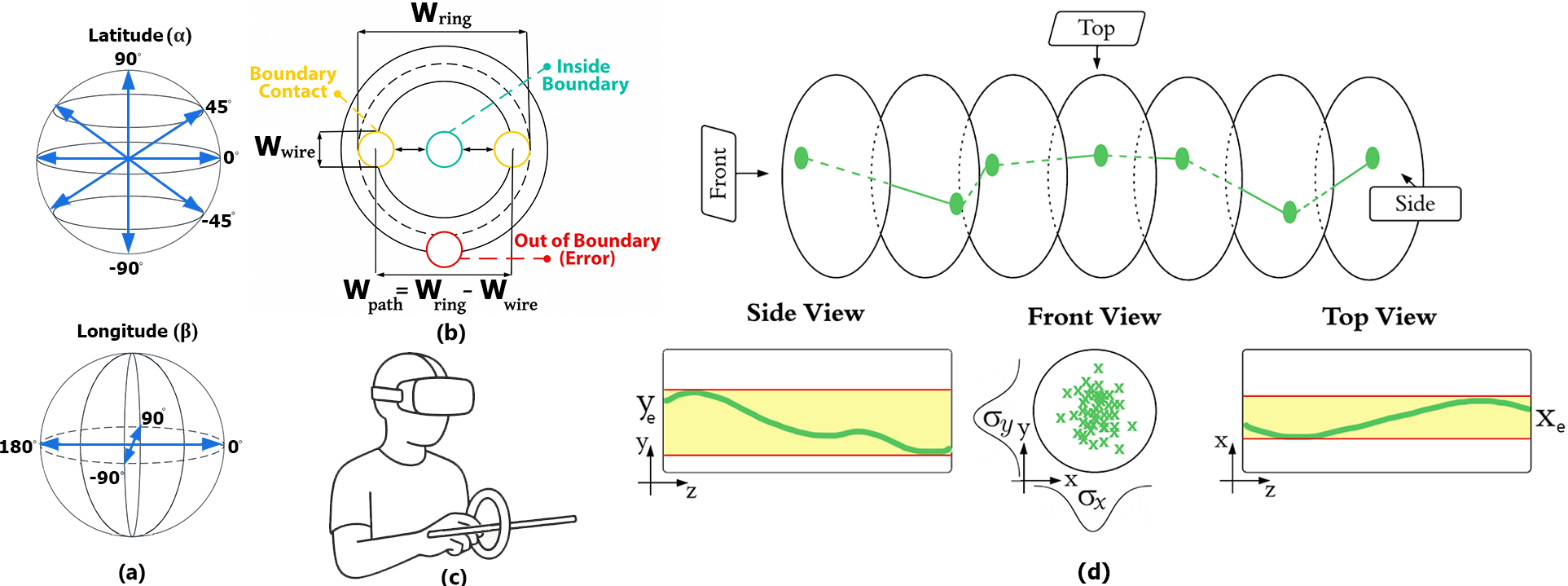
Throughput is a widely used performance metric, combining speed and accuracy into a single measure, while reducing the effect of subjective speed–accuracy trade-offs. Despite its wide application in 2D steering tasks, its direct extension to 3D presents unique challenges since 3D trajectories exhibit higher variability, and perceptual–motor factors undermine existing formulations. Consequently, throughput has not been systematically adopted for evaluating steering in 3D virtual environments. In this paper, using a controlled virtual reality user study with a ring-and-wire task, we introduce and validate a novel throughput formulation for 3D steering based on the bivariate standard deviation of the trajectory for the effective width calculation. Our results show that this formulation provides smoother throughput values across subjective speed–accuracy differences and improves model fit compared to traditional approaches. This work advances our theoretical understanding of the Steering law in 3D contexts, provides researchers and practitioners with a robust evaluation method, and establishes a foundation for future studies of complex 3D trajectory interactions.