Evaluating the Vergence–Accommodation Conflict in Gaze-Based 3D Target Selection Article
Mohammad Raihanul Bashar, Mohammadreza Amini, Aunnoy K. Mutasim, Mayra D. Barrera Machuca, Wolfgang Stuerzlinger, Anil Ufuk Batmaz
Abstract:
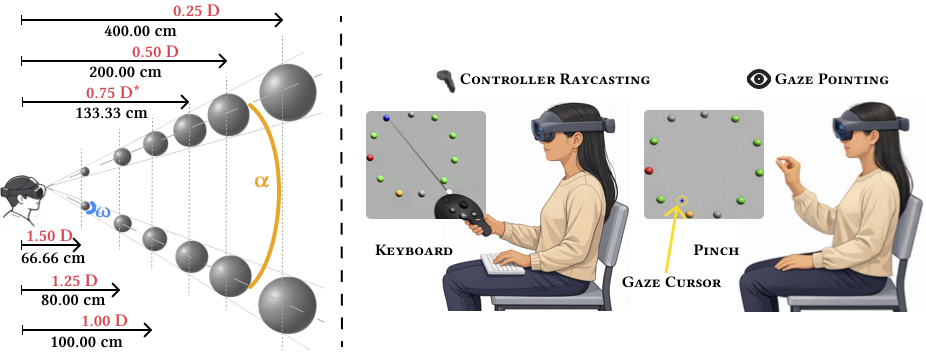
State-of-the-art head-mounted displays (HMDs) enable gaze-based selection in virtual environments. Yet, these HMDs suffer from the vergence–accommodation conflict (VAC), which is known to affect interaction performance. The VAC might influence gaze-based selection performance because it directly affects eye-movement behavior. Thus, in this paper, we investigate how the VAC influences gaze-based 3D target selection across varying depth conditions. Our results show that as the (visual) depth increases, user performance significantly decreases with gaze-based selection. Moreover, a previously suggested ``Variation in Diopter'' Fitts’ law model captured this performance change better relative to a linear model. These findings provide evidence that gaze-based pointing is negatively affected by the VAC and highlight the importance of accounting for depth-dependent factors when designing gaze-based interaction in 3D environments.