Modeling Throwing Selection in Virtual Reality Article
Jae-Yeop Jeong, Wolfgang Stuerzlinger, Jin-Woo Jeong
Abstract:
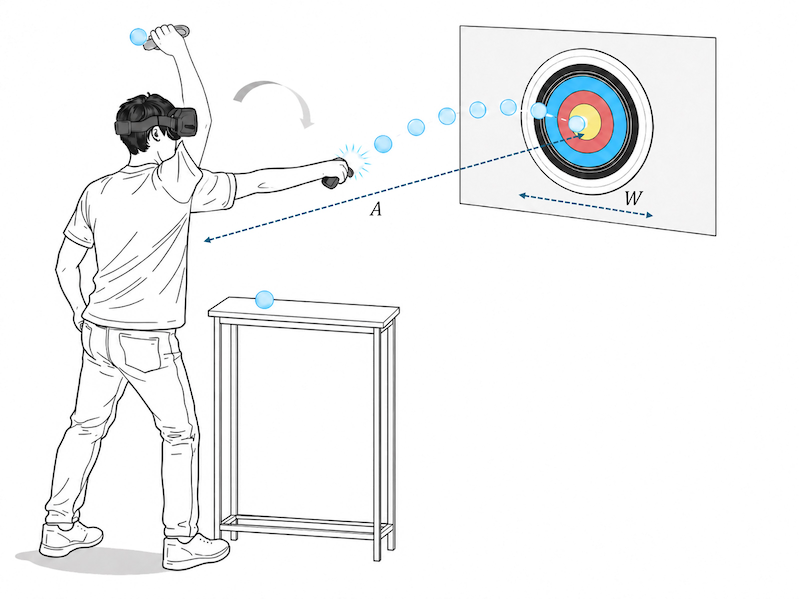
Throwing is a natural and embodied interaction for selecting distant targets in virtual reality (VR). Unlike conventional pointing, throwing is ballistic: once released, the trajectory can no longer be corrected. Despite its practical importance, throwing-based target selection has received relatively little attention in human behavior and performance modeling, making systematic design and evaluation still difficult. In this paper, we investigate throwing-based target selection in VR and propose predictive models for its behavior and performance. Through a controlled user study manipulating target width (W) and movement amplitude (A), we measured planning time (PT) and endpoint distribution. Our results showed that PT increased systematically with task difficulty, following a pattern similar to movement time in Fitts' law. Throwing endpoints were also generally well approximated by a bivariate Gaussian distribution, and target parameters significantly affected both endpoint bias and variability. Based on these findings, we derived a probabilistic accuracy model that predicts target acquisition performance. The proposed models showed high goodness-of-fit, and the accuracy model was robust under leave-one-condition-out cross-validation. Our findings provide a quantitative understanding of throwing-based target selection and support the design of throwing interactions in immersive environments.