ScaleCue-WIM: Boundary-Controlled WIM Scaling for Scale-Aware Navigation in Multiscale Virtual Environments Inproceedings
Junkun Long, Wolfgang Stuerzlinger, Pan Hui, Hai-Ning Liang
Abstract:
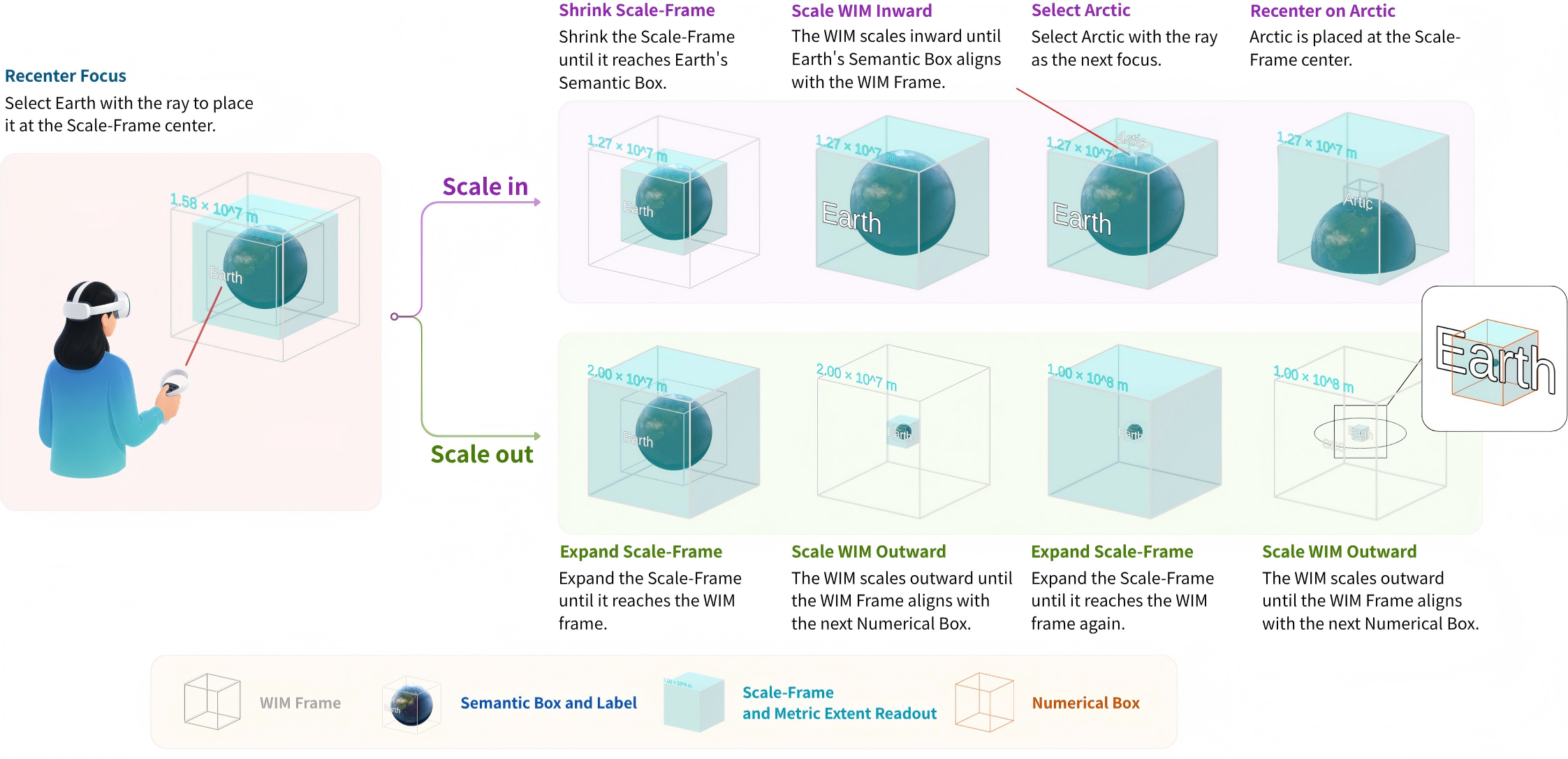
Navigating multiscale virtual environments (MSVEs) requires users to understand their current scale and follow scale changes during navigation. World-in-Miniature (WIM) interfaces provide an exocentric preview for inspecting views across scales. A remaining design question is how to connect semantic and numerical scale references to preview adjustment so that users can follow these changes. We present ScaleCue-WIM, which combines these references with a central Scale-Frame. Users resize the frame to select an extent; reaching a boundary triggers automatic preview scaling, during which the frame remains visible as a reference. We conducted an exploratory within-subjects study with 24 participants comparing ScaleCue-WIM with Cue-Augmented Scaled and Scrolling WIM (CASSWIM), an author-constructed continuous-scaling workflow with comparable scale cues. Across the guided cross-scale routes tested, participants completed routes 7.37 s (8.7%) faster and used 4.66 (20.0%) fewer scale-control operations with ScaleCue-WIM. Participants also reported stronger perceived scale support. Participants described how the workflow helped them interpret scale changes, while also noting learning and control trade-offs. These findings offer insights into how WIM interfaces can support users’ understanding of scale as they inspect and adjust previews for multiscale navigation.