Dynamic Vergence–Accommodation Conflict: Effects on 3D Selection Performance When Target Depth Changes Article
Zahra Rasoulifar, Rumeysa Turkmen, Mayra D. Barrera Machuca, Wolfgang Stuerzlinger, Anil Ufuk Batmaz
Abstract:
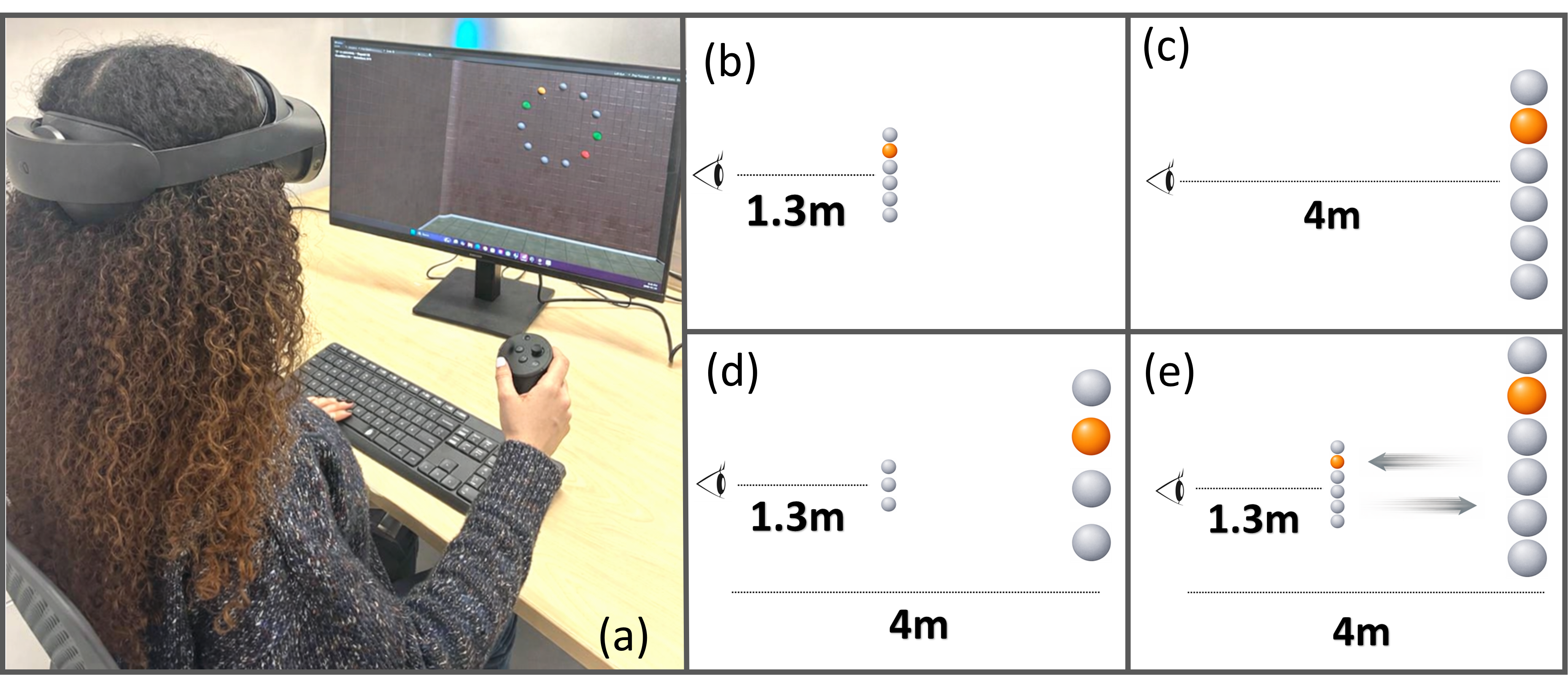
The effect of the Vergence-Accommodation Conflict (VAC) in state-of-the-art head-mounted displays on 3D interaction performance is well-studied in scenarios where targets remain stationary at a fixed depth. Yet, many VR applications include targets moving continuously toward or away from the user, causing vergence demand to change over time while accommodation remains fixed at the display focal plane. We study this scenario using an ISO 9241-411 multidirectional target selection task with: No VAC (targets at the display focal plane), Constant VAC (targets further from the focal plane), Varying VAC (targets appear at both No VAC and Constant VAC depths across selections), and Dynamic VAC (target depth changes continuously during acquisition) conditions. In a within-subjects study with 24 participants, Dynamic VAC produced slower selections, higher error rates, lower accuracy, and reduced throughput compared with the No VAC condition. To account for target movements in depth, we propose an extension of Fitts’ law that models the additional performance costs introduced by continuously changing vergence demand. Our results provide guidance for modeling and designing interaction techniques in depth-varying 3D environments.